Minter Dialogue with Dr Jack Kreindler
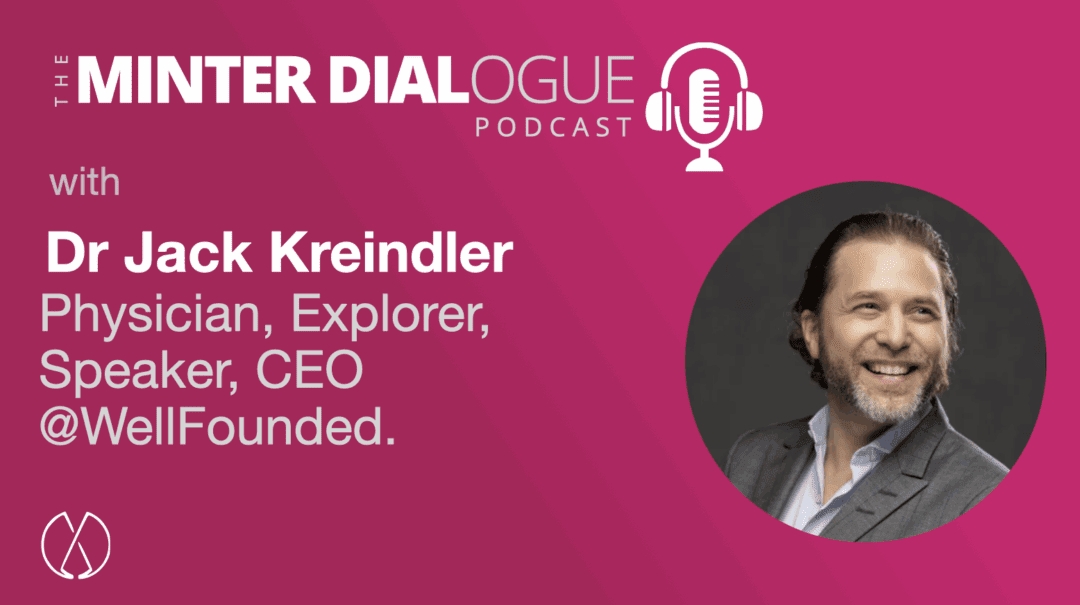
I had the pleasure of welcoming back Dr. Jack Kreindler, a physician, entrepreneur, and physiologist. We delved into his Antarctic expedition, which revealed fascinating insights about gender differences in endurance. Jack shared his experiences of resilience in extreme environments and how these lessons apply to everyday life and business.
We explored the importance of embracing risk and discomfort to build resilience, both individually and societally. Jack emphasized the value of creating “temporal landmarks” and intense experiences to enrich our lives, rather than simply extending them.
Our conversation touched on the entrepreneurial mindset, with Jack likening building a company to climbing a mountain. He stressed the importance of creative problem-solving and maintaining a positive outlook in both business and adventure.
Finally, Jack shared details about his performance medicine practice, Well Founded Health, which helps driven individuals optimize their health and performance. His parting words, “Don’t die dull,” encapsulated the spirit of our discussion about living life to its fullest.
To connect with Dr Jack Kreindler:
- Check out the Well Founded site here
- Find/follow Dr Jack Kreindler on LinkedIn
- Find/follow Dr Jack on X (formerly Twitter)
Other mentions/sites:
Further resources for the Minter Dialogue podcast:

Meanwhile, you can find my other interviews on the Minter Dialogue Show in this podcast tab, on my Youtube Channel, on Megaphone or via Apple Podcasts. If you like the show, please go over to rate this podcast via RateThisPodcast! And for the francophones reading this, if you want to get more podcasts, you can also find my radio show en français over at: MinterDial.fr, on MegaphoneFR or in iTunes. And if you’ve ever come across padel, please check out my Joy of Padel podcast, too!
Music credit: The jingle at the beginning of the show is courtesy of my friend, Pierre Journel, author of the Guitar Channel. And, the new sign-off music is “A Convinced Man,” a song I co-wrote and recorded with Stephanie Singer back in the late 1980s (please excuse the quality of the sound!).
Full transcript via Flowsend.ai
Transcription courtesy of Flowsend.ai, an AI full-service for podcasters
Minter Dial: Doctor Jack is back. We had our first podcast, and I looked for 2018. So, that’s going on a few years. A great conversation that was, I entitled it “Building cross disciplinary teams to bring futuristic solutions.” In the interim a whole tonne of stuff has happened including a little pandemic, a few notches and wars. I mean, wow. But for those of you who don’t know Jack, start with who are you?
Jack Kreindler: My name is Jack, Jack Kreindler. I’m a physician, an entrepreneur and a physiologist. I also dabble a bit in extreme environments accidentally and kind of polar expeditions and high-altitude trips which we call experiential medicine. But essentially, I’m a doctor. I’m a doctor with a 26-year practising history. Before that, before medical school, I was doing stuff for the, for the web, the early web days, pre-Google, building interfaces for software. So, I’ve had a, I’ve had a combined technology and medical career that goes back 35 years and yeah, so, so that’s me.
Minter Dial: How much would you cringe if I said you’re a true Renaissance man?
Jack Kreindler: I’m every cell in my. But I, I don’t, I don’t go for titles and things like that. But yeah, I, I, it’s okay. A lot of things.
Minter Dial: Yeah, it’s okay if someone else says it. I think the thing that let’s. Amongst the things that I wanted to talk about with you was your trip to the Antarctic because you did that with two people I’ve had on my show. One my cousin, one, my friend Kevin Ryan and Fabrice Granda.
Jack Kreindler: Indeed, two of them. In fact, I can see both of their shadows at the moment. On my wall we have a beautiful, a beautiful picture of us crossing the, the Antarctic plateau. Yeah, that was, that was a mammoth trip.
Minter Dial: Well, so you wrote, at least you spoke about it at the time. Says an endless, endless white disc of ice where anything can happen even in the most predictable, predictable environments. What did that expedition with those, the people with you of course teach you most about uncertainty in life and medicine?
Jack Kreindler: Well, starting with the medical part, that the whole purpose of the expedition was to see if we could study the difference between male and female physiology and psychology in hyper endurance environments. So, there appear to be significant differences in the amount of muscle mass and possibly also the amount of effort endured by men versus women. So, men lose more muscle mass and seem to not do quite as well in general as women in hyper endurance settings. Now what is hyper endurance? That’s a key question. It’s essentially where you’re working your ass off a very long time burning maybe two marathons worth of calories in very, very austere, cold, high remote environments and you just can’t consume as many calories as, as, as, as you burn. So, and you do that day after day. And that’s a sort of a very.
Minter Dial: Broad.
Jack Kreindler: Classification of what maybe a hyper endurance event is, as opposed to an ultra-endurance like marathons and sporty type things. And that was the purpose of the expedition. So, could we find out what it was that helped women essentially survive these kinds of conditions better than men? And we did all of that work, but it was getting, getting the, getting the funding for such kind of expeditions is extremely hard. The military and academic communities can only afford fairly limited, fairly limited budgets for these kinds of things. So, I decided I was going to rope, rope in some of my good friends, two of whom you mentioned, Kevin Ryan and Fabrice Grinder. And we, we got a six other really great, very successful people as well as, as well as Kevin and Fabrice to, to fund along with some other supporting in funders a what ended up being the largest expedition skiing to the South Pole. Two of them, a 60-day coast to pole expedition. And the one which I led, which was the, which was the last degree, which is unacclimatized, being dumped in the, at 89 degrees south in the middle of this epic endless white disc at 3000 metres altitude. But because of the way the earth spins and atmospheres spread, it’s more like four, four and a half thousand metre altitude at minus 40 centigrade or Fahrenheit doesn’t matter, it’s the same. And yeah, and you’re dumped there unacclimatized and it’s over to you. Let’s see, let’s see what happens. And that was, it was a huge, a huge learning experience both from a scientific and a medical perspective, but also personally, probably the, probably the most moving thing that has happened to me and maybe to all the other people in the, in the expedition apart from obviously things like major births, deaths, marriages, those kinds of things. But it, it was a, it was an enormous learning. There is, I mean it’s easy to forget I forgot it this morning and I’m sure everyone else does too. How precious it is to wake up with warmth and with shelter and to be able to press a button on your kettle or your water filter and get instant warm warmth that you can make a cup of tea out of and that you get a hug from someone you love and that you pick up your phone and you’re contacted with the, you’re in contact with the rest of the world. And just all those very, very basic things that we so often forget and have to forget really to get on with more sophisticated things are the very matters that you are reminded of in a, in a stark and frank way. And they do. Those experiences in extremes do seem to permanently burn into your psyche. An appreciation of the very simple fundamental things of shelter, warmth, food, company and contact with people. So, yes, it was not just a study of human physiology but also an investigation, personal investigation for many of us into what’s important in life.
Minter Dial: Well, coming back to the medical experiment with regard to women and men, what I heard you say, and I assume there were some women along with you, was that women endure better these type of environments. So, first of all that type that, that, that if that’s correct conclusion, it goes against what we typically say which is men are the best to go send for a risky adventure, so send them out to do, to do the old stuff. Women are better suited to do things in a different type of environment. That seems to be inaccurate. Therefore as in terms of what we’ve always thought.
Jack Kreindler: Yeah, I mean I kind of blame it on the ancient Greeks. I know this is a little bit tangent, but as a Renaissance man yourself, Minter, I’m sure you’ll appreciate this tangent. The sport, modern, modern spectator sport and the Olympics And so, forth were really orientated around what audiences were prepared to endure for how long. And so, sprints have always, I don’t know if you ever watch the Olympics, but this less than 10 seconds seems to be the most interesting thing to people. I mean why is something that lasts less than 10 seconds more interesting than something that lasts more than four hours? But eventually after four hours people want to go home. They’re fed up with buying popcorn, even ancient Greek popcorn and they, they’re just, it’s bye bye, I’m, I’m off. People do not have attention spans that are longer than that and, And so, all of sport has been orientated around quick dopamine releasing fixes. Mostly you could argue potentially that a snooker and, and, and bowls was, there’s an exception or exceptions but in general men are suited to sprinting, to fast burst type things, more than more than women’s female physiology is. But when it comes down to iron man length endurance events and hyper endurance especially, the crossover comes at around 100 kilometre running, ultramarathon type settings where there’s calorie deficit, the gap between men and women Rapidly closes. And then when you get into hyper endurance where it’s very prolonged day after day calorie deficit, it crosses over the, the advantage of having the strength and the power of generally speaking male, male physiology is outweighed by the energy preservation and psychological perhaps also human interaction type advantages that that female physiology seems to lend itself to.
Minter Dial: Fascinating. So, in essence there’s a body type which is more which the way I interpret it is better for fast action sprints, weightlifting sort of ideas. And then the endurance idea, the ability to last longer both mentally and physically is something that the female physiology is better at.
Jack Kreindler: I mean we, we don’t exactly. These are only scratching the surface type experiments because they’re small numbers. But it seems as if nature is leaning towards spreading its net relatively wide and saying okay, here’s a bunch of expendable things that can. I’m, I hope I’m allowed to use this language, but you can use. I can, you can.
Minter Dial: No, no, no, everything’s good, everything’s good.
Jack Kreindler: Fighting and, and you know like lifting things and shifting things around. Male physiology is, is, is very suited to that. Surviving long term migrations, carrying a child in your arms, perhaps also breastfeeding as well as carrying a child in your womb and growing a new being as well as surviving yourself and moving for extended periods of time. It seems as if nature is saying okay, there are some things to do with hyper endurance that maybe lend themselves more to, towards the, the, the other, the other half of the species. Now this is very much again scratching the surface the beginnings of it, but it seems to make some sense from an evolutionary and survival perspective.
Minter Dial: Did you write up a report on this? I assume with regard to some medical journals.
Jack Kreindler: Yeah, there is, there are, I think we’ve had six papers published so far or about to be published and a lot of presentations at, at conferences. So, it’s been important work for both understanding, fueling choices of who you might select for particular roles in the military, what you might be wary of when somebody’s in a, in a, a similar situation for extended periods, periods in intensive care going to the moon or Mars. Well, they usually have, I mean those funnily enough you usually have enough food. But it’s, yeah, it’s, it’s already yielded. We hope to, I, I’d say we’d hope to publish maybe a dozen or more papers over the coming years from, from what we’ve learned and we’ve also really begun to understood the performance of particular wearables and wearables in general for doing really Important but difficult to conduct research in hard environments and whether specialised equipment or today’s consumer wearables can be used. That’s another really important finding from this is the practicality of the sort of data collection tools that we today use. You may have an OURA ring, I don’t know, or a Whoop or an Apple watch or I have, I have.
Minter Dial: An Apple watch and a Dexcom because I’m a type 1 diabetic. So, I, ah, track this device.
Jack Kreindler: Yeah, we use both of those devices. So, yeah, that’s the other learnings.
Minter Dial: Of course you need to have good battery life which I’m sure in the cold is a little bit difficult talking rather than just the physiological components we just talked about. As you know, I did a film about the Second World War in the prison camps and what allowed some of the prisoners to endure, 50, 42% of whom were killed as prisoners and what were the elements that allowed for people to go through that type of very difficult conditions. I’m wondering in your study, what type of things did you observe made for more successful adventurers with you? Are there any things that stood out?
Jack Kreindler: I’m always reminded of two important people who are inspirations to me. One Viktor Frankl and the other one is Sir Ernest Shackleton, both of whom talked similarly about the ability to reframe your situation and almost choose the way in which you perceive something which is clearly not ideal and whether you can enjoy certain situations, but you can certainly find pockets of solace and positivity even in very dark situations. Those, those were two inspirations which I felt became part of my journey when I was on, on the trip and many others on the trip also described the same. When the going was really, really tough, your, your body just. And your brain, they want you to stop and there’s this automatic reflex catastrophizing kicks in and it takes a very conscious effort to take that natural catastrophizing and to pull yourself out to a different level where you can look at that and almost reflect on what you’re thinking about. And it’s a, it’s like a meditative state. It’s the sort of thing that people who are practises, practitioners of meditation, martial arts, you know, psychological resilience techniques, they, they do describe this, this, this quality which you kind of want in people automatically who come on such expeditions, but you can learn it as well. And it’s this kind of true optimism. I think, I think Shackleton said that optimism is true moral courage. And that is, I would, I would tend to agree with that. But finding optimism when, when the lights are out and things are dark and not looking great and you just wonder, oh my goodness, how on earth am I going to carry on for the next 10min minutes or even at the end of the 10 minutes for the next hour and then the end the hour the next day and then the day the next week and the week the next month. You think, how on earth am I going to get through these next 10 minutes? And then finding that inner strength is a. Is. Yeah, I think that’s probably one of the greatest things you can learn in life in general. But certainly if you have that innate quality, it is unquestionably useful and often leads to better jokes because those people tend to crack jokes even when, and increase the optimism even when, even when the going’s tough. But yeah, so that was one clear thing. I think one of the biomarkers we saw when we were reflecting on the daily quite long questionnaires that we filled out each day on how people felt, we scored levels of effort and reasons for people feeling great and not great during these tough. During tough days was the correlation between communication and the ability to share load, both mental load, but then also physically the ability to share physical load. The actual weight on your sled was a key indicator of how well people did even when the going was tough. And I would argue that a lot of men versus the women on the trip tend to automatically just crack on, look forward and they don’t sort of think, oh my gosh, you know, how am I feeling right now? How’s the person next to me feeling? Let’s check in on them, let’s check in on myself. Let’s admit that I need some help and pass on some load. That seemed to happen perhaps a little bit more automatically in. And I don’t know whether this is nurture or nature or both, but there was almost a schadenfreude in, in men. You see this a lot in expeditions where, where people just go, oh, I’m doing better than you. I’m going to crack on. And it’s quite nice to see you suffer a little bit and breathe harder than I am. And it, Yeah, I, I think the expression of load, the feeling of load and the sharing of load seems to be a critical factor in, in success in these kinds of environments.
Minter Dial: Most telling, I, I was thinking about a book in the, in the POW situation where there was a priest called Sydney Stewart who wrote the book called Give Us this, Give Us this Day, which is a beautiful Account of how in the middle of all that horror he was able to give time to others while he hadn’t eaten anything in days or drunk water. And how do you give to others A little bit like you’re saying, have that notion of, of sharing, load sharing time, sharing communication. Even though, you know, you’re kind of focused on your survival, moving out of your shell to embrace the fact that you have a community around you.
Jack Kreindler: It’s extraordinary. I, I often find myself, especially as an expedition leader, even though I’m absolutely terrible, I really the, the thing that I absolutely just want time is to curl up in my sleeping bag and just get a little bit of rest. But you somehow find it in yourself to go into the tent with a smiley face and say hello squirrels, how’s everyone getting on? You know, like let’s get out the blisters and have a, and have a competition here. Finding that in yourself changes your, your physiology almost instantly. It’s a, it’s. But finding, finding the ability to turn that switch on is sometimes hard and it’s understandable that we can just curl up in a ball and it sounds.
Minter Dial: Like a precept of, of PNL or NLP. I can’t know which one it is. Neuro linguistic programming. How you tell yourself you’re in a good shape and, and that helps you to become in that shape. And yet it brings up this tension between stiff upper lips, showing the way, modelling the behaviour and actually being able to represent the other side of me, which is I don’t feel well today. I need help today. And that balance for leaders in general is always complicated because you are designed to lead and lead by example and fully forward and give that vision, give that energy because that’s what you’re paid for. At some level you are the top guy or woman. At the same time, if you don’t know how to just circle back into. How am I actually feeling? Oh my gosh, reveal vulnerability. I’m feeling shit. And you don’t go into the tent saying, well how are you guys? How are all the squirrels doing? You go in and you like a pat faced because that’s my real side.
Jack Kreindler: It’s a balance. And one of the elements of self-leadership or team leadership or doesn’t matter just even as a role model, as a parent to children is that you want to be, you want to be positive, you want to be the, the solid ground. But if all you are is an unmovable, unshakable being, then you’re also unrelatable. And so, having the Best leaders I’ve seen, Minter, are the ones who have an uncanny amount of positivity, but also can deeply relate and share their own vulnerability relating to other people’s difficulties and, and doing those aikido moves of kind of swinging the person round from, you know, direction of negativity back into more groundedness themselves. But it is, it is a, it is a balance. And I don’t think these are the things that are easily taught. I think they come from experience as well. But yeah, you can become too leadery and too positive and start to sort of feel like you’re pushing people against what they naturally are and can be. So, coming back to your point about the POWs or the, the prisoners that you, that you mentioned, finding space for people, it’s not just about saying, hey, pucker up, fella. Yeah, it’s. It is. It, it is much more subtle than that. You need to appreciate how people are getting on and to show that you actually have emotion and, and empathy for them too. Yeah.
Minter Dial: Then their words of counsel or encouragement, comfort feel more real. What. One of the things that I picked up was this notion of hope. But I wanted to quote you in another thing because I did a little bit of research on you. You said you can’t go into the wild without believing you can get to your goal. An irrational amount of self belief is essential. And as a scientist and a doctor, as you are, I was wondering about how you balance that irrational confidence with scientific realism.
Jack Kreindler: Well, if you go into something saying you’re not going to make it, you generally don’t. It’s the, the most classic example of this. I, I think is the extreme example of when you are rock climbing on a vertical face where gravity tends to have a rather unfair advantage over you because you really are not designed to stick to a vertical face. That’s not what we were designed to do. And in gecko like fashion, if you for a moment believe that you can make the next step assured or assuredly you are much more likely to make that next step. It’s not that it’s outside of the bounds of probability that you can make that step, but it becomes incredibly probable that you won’t make that step if you start to shake and believe, oh, there’s a low chance I can, I can do this. What we as human beings are capable of is far, far beyond what we generally feel we’re capable of. And tapping into that. And it may, it may not actually be irrational. What it is, it’s more like, it’s more like switching off the, the fear component of your being, which is kind of saying to yourself, if I don’t make it, I die. There is a high probability of that happening, but it’s well within your capability to be able to do it and not die. So, it’s less about choosing things irrationally, it’s much more about just switching off the. Switching off the probability calculator in your head as to what happens if you don’t make it and focus on what you can.
Minter Dial: Yeah, yeah, well, I, I want to get. I mean, where we. One of the areas I want to explore with you, Jack, is this notion of the health and performance that you. That you do as a practise, yet tying it in with what you do as an adventurer. The idea of resilience is a. A topic people talk about, but I feel shy away from in the reality of facing risk and facing down death, knowing that essentially we all will die. There is no such thing as anti death or making death a disease to fix.
Jack Kreindler: Some would argue otherwise, but yeah, maybe in the background of San Francisco here often. I’m not in San Francisco, by the way. This is just a.
Minter Dial: For those of you who don’t have the video, you have a beautiful view of the Golden Gate Bridge. But the, the issue here is that I, I feel as a society, especially in the west, we’ve moved away from tolerating risk. And, And therefore, when you don’t face risk, when, when the proverbial shit hits the fan, you’re like, oh my gosh, it’s the end of the world. Because I’ve never been able to face anything. And you as an individual have, have really pushed bounds. And I have to imagine that that has deeply influenced your profound ability to be resilient. And, and then comment on what you think is the way society is going and what is your opinion about this idea of tolerating risk and building resilience through shit?
Jack Kreindler: There’s a great book, the author, I can’t remember the name of ever. It’s called, it’s called Antifragile. You almost certainly have heard of it.
Minter Dial: I’ve read it.
Jack Kreindler: Name of the name of the author. Can’t remember.
Minter Dial: Yeah, we’re going to have to look it up as I, as you speak, I’ll afterwards.
Jack Kreindler: Excellent, important, important lessons there, which are the kinds of things that if you read the prose, poetry and narratives of the great explorers in, in days where there wasn’t GPs or people to rescue you, they talk about this resilience, if you like, or endurance. And I would say that it’s important to differentiate between endurance and resilience. Resilience is not the same as endurance. Resilience, if you look etymologically at it, it’s re, which means again, and celere which means to jump or to bounce. And so, it literally is once you have collapsed, once you have fallen over, it’s bouncing back up again. That is what resilience is. But people think resilience is the ability to endure. Endurance is another matter. I think what we, what we do in a lot of society today is, is we feel that it’s a human right to, to. To only feel comfort and only receive what we quote unquote, deserve what, whatever on earth that means. Coming from a background like me, I don’t generally feel as if I deserve much. I think the more that we come from a world of wealth and comfort, we probably feel as if we deserve more and that it’s, it’s, it’s sort of anti-human rights to, to not be given all the comforts and luxuries that we, we think we deserve. So, culturally we have not really in the last x many years faced true discomfort. Perhaps the pandemic reminded us of what it’s like to, to, to endure difficult times and for some to be truly resilient and to be knocked right down to the very core of your self and, and to build yourself back up again physiologically as well as psychologically. But in general, we, we don’t live in a very, in very tough times in general in, in this part of the world. For most of the people that are listening to this, that is not the majority of the planet. But I’m just talking about the listenership and of, of this kind of podcast. We think that by falling down we’re going to get damaged and traumatised. But it is only through the process of falling down do we develop resilience. Resilience only comes from bouncing back up from zero. That, that is what resilience is. It does not come from enduring, it does not come from comfort. It is, it is like when you make a dreadful mistake on the piano in, in your grade three exam and you’re speaking from experience. Well, you know, I started learning the piano at 47 and I’m still terrible. I couldn’t pro, I couldn’t even vaguely pass a grade three. I can promise you that I can play some shitty jazz. But, but it’s, it’s that forgetting the line on stage at your, and your first play at school, it’s the, it’s the dreadful mistake that you made where, I don’t know, you’re, you slip up and break your leg and think, oh my God, I’m never going to play football again. And you go through those, those lows and you find it in yourself to build yourself back up again. We, we don’t want to wish any bad things upon anybody, but that’s where, that’s where true moral courage is born. And I think we, I think we shy away from those sort of scenarios and conditions which make you resilient. Going on little expeditions that we know won’t kill you. But you will all have your moments. Even the little three-day things that we do in Norway. Everyone, it doesn’t matter how fit, how strong they are, everyone has a moment, they have a moment where they, how on earth am I going to drag this sled up this slope? Or oh my goodness, I’m so cold, or just fighting hunger, fighting yourself and your energy levels and digging deep into yourself with other people around you to help you. Often it’s, you realise that you do have the ability to bounce back and that resilience grows and that can be translated into other aspects of life. But perhaps we live in just too comfortable an environment nowadays, both occupationally and environmentally and also socially to, to accept that resilience only comes from falling down and we need to fall down.
Minter Dial: I entirely agree. I, I, when I was listening to you, the three-day journey, it, it felt more like there was a grayer zone between endurance and falling down in that space. Or maybe we can just pull hairs on that one. But the idea of introducing risk into lives, it seems to be anathema to our current moral compass because anything that’s dangerous is bad. My favourite saying that I like to tout a lot is an adventure without risk is not an adventure and a life without adventure is not a life. And yet here we are promoting longevity anti senescence with the hope to live forever or at least longer, which kind of means by nature shying away from risk. Because if I do anything that’s risky, it’s going to, it’s going to break some tissue or break a bone. And by the way, in the, in the examples you were citing Jack, about forgetting a line. I, I remember forgetting the first line of my first major role play. Oh yeah, yeah. And, and then I had the other one you mentioned where I had a surgery on my shoulder and I was told I had to put a cross on my tennis. You know, these, these are things we all have to face and how you deal with them. Are you going to Be the, the victim of them or are you going to act and, and come out of them with some. So, so with that jumble of things, Jack, how do you see we should be changing things in society and specifically about raising children?
Jack Kreindler: Well, you also mentioned about our risk taking in this sort of concept of extending health, health span, longevity as well. I’m a doctor. At the end of the day, that’s what I do mostly. And so, maybe I can, maybe I can put your question into the context of medicine. Like what can we do as society to both become more resilient, less fragile, but also help us live more, more healthily?
Minter Dial: I got the name by the way of the author, the Nassim Taleb.
Jack Kreindler: That’s it. And, And so, I just want to point out one thing, that people are taking remarkable risks within the fear of them not dying. They’re not just not taking risks, they’re doing some pretty bizarre things medically with untested molecules, experimentally chucking loads of things into themselves. Only a few years maybe before we get the data readout. So, it’s kind of very bizarre what some people are doing. They seem to have a very great fear of disintegrating thanks to the powers of entropy, which will happen at some point, alas, but are taking remarkable risks for not wanting to die. And that sort of is a paradox really in a lot of ways. But coming back to your point, what do we need to do to increase our resilience? I mean, I, I think, and I’ve seen that the sort of things that can, can help us develop resilience physiologically are also jolly good for our health. So, putting ourselves through much more rigorous, vigorous, adventurous exercises, not just going to the gym, but planning holidays, for instance, that involve some form of adventure. I, I, we call that experiential medicine. It’s, it’s not just great because you’re getting a cold plunge for three days in, in an icy place. It’s not just because you’re getting a workout and doing high intensity training. It’s, it’s the whole thing of being in an austere environment, soaking in nature, appreciating deep, wonderful and awe inspiring things and putting yourself in a modicum of risk, putting yourself in a reasonable amount of danger where you’re almost certainly not going to die. But you will find yourself perhaps with a tear in your eye and thinking, gosh, can I actually get over this ridge? Those are the sorts of things that I think are absolutely fantastic things to do individually or with families. And we just don’t we just simply don’t do enough of them. So, I, I would say that to develop resilience you just have to get yourself out into difficult situations and to try and enjoy those situations. So, what, why not try and absorb some of nature? Whether you’re yachting on an ocean, whether you’re climbing in the mountains via Ferrata and Dolomites, whether you’re, you know, trekking through a desert, whether you’re, you know, I don’t know, going in a rally, in a car across, across some arduous terrain. It doesn’t have to be, it doesn’t have to be specifically remote places like Antarctica. But those are the things that we really, really are missing. Rock climbing, climbing at the climbing wall is an unbelievably great hack towards achieving some, some of those, some of those elements of resilience that I think more of us need and, and you know, doing less watching of these things on, on screens. But yeah, that’s in a, more, at a more societal level. Gosh, people are talking about, well, is military service something that we should all do? You know, we, we love our freedom, but freedom doesn’t come free. Is that something that is good for. So, I, I’m not a sociologist, so I, I wouldn’t know. But yeah, again, it’s, it’s about finding ways to put ourselves in situations both individually and as a society that pushes us perhaps a little bit beyond comfort where we will have to bounce back and there, there will be risk, people will get hurt. But is it better to, is it better to live individually or as, as a group of us with more camaraderie, with more social cohesion, with more resilience, with more joy of simple things rather than kind of in a risk free, comfortable existence with white picket fences and the security dogs who bark at anyone that, you know is in your neighbourhood? I don’t know, I’ve got some views on this, but yeah, again, not a sociologist, Minter, but I think it’s an.
Minter Dial: Important conversation, Jack, that it reminded of a conversation I had with a lady who was at the time, I think, 98 years old. Her name was Doris and she lived through the Second World War, lost her husband and the bombings and all that. And, and she said something before she died which was, you know, Minter, I’d rather die living than live dead. This is a lady who had been hit as a 95-year-old by a car on a pedestrian crossing. And she still had that attitude. And I think it speaks volumes to the type of attitude we have and you having a kid, we’re such in a world where, oh, we need to protect and show care and that’s the right way to go. And there we are now thinking about rugby without tackle. It feels like if we take the tackle out of rugby, we take the, the risk out of living and probably end up with comatose people on sofas doing nothing, because that way I won’t die quickly.
Jack Kreindler: Yeah, I mean, we are all going to end at some point and we have a much greater chance of that. There’s much more experiential intensity or epistemic depth to an experience you can have when you’re younger than when you’re too frail and your senses are dulled to be able to fully engage with it. So, if you think of life as just, you know, the length of, the length of the x axis, then fine, then live your life like that. Be a flatliner. But really, if you, which is, which.
Minter Dial: Is ironic, a flat line, true.
Jack Kreindler: Yes, indeed. You’re flatliner. You’re kind of dead, but alive. Right. But I very much look at the intensity of life is the, is the amplitude. It’s the number of spikes, it’s the number of peaks and the number of troughs. And if you extend that very big wiggly amplitude and stretch it out, it’s a lot longer than just the x axis. So, yeah, it’s finding, finding the opportunity to create temporal landmarks, to create firsts, to push yourself. Firsts create surprise. They create, they crystallise memory. They, they literally create this, the space between the days and the years in your, in your life. That is really what extending your life is. It’s about the perception of time and the intensity of experience or the depth of experience. It doesn’t have to be necessarily climbing Everest, but it can be the care that you took in, in helping your child learn the piano. But, but truly doing that and, and, and not just, you know, living comfortably and saying, hey, that was easy, let’s just, you know, let’s just retire and go to Spain and sit on the beach and drink sangrias in, in the local pub. I mean, each to their own. But my, my view is, and from what I’ve seen of patients at the end of their days, and I, I have seen a fair few people in the most vulnerable moments of their life where they’re having to kind of face the results of entropy, the, the bad luck early on in their lives or maybe, you know, richly and latterly in, in their 80s or 90s or, or even hundreds, the folk who have really lived are the ones who, irrespective of their amount of time, feel very fulfilled.
Minter Dial: I love it. Listening to you, Jack, it makes me think this amplitude that you’re talking about that expends over time. It’s the experiential experiences that you do with your business as a doctor. But also I feel like that amplitude is actually the collection of stories to tell. And I’m wondering if there’s not like within amplitude, this innate need which. Or feeds the stories that we tell.
Jack Kreindler: I mean, everything’s a narrative, right? We like our lives are the, are the narrative that we kind of construct for ourselves. And in those, in those long epics are little chapters and little stories and the power to reminisce against meaningful stories that make you laugh and connect you with the shared stories of others. Or the. I mean the most fun I ever have is, is after it’s called type 2 fun. I don’t know if you know what the difference in type one fun. Type one fun is just fun.
Minter Dial: Well, I’m a type one diabetic, so that’s what my mind.
Jack Kreindler: Okay, so this is very different to type 1 diabetes and type 2 diabetes, but type 1, type 1 fun is just fun. It’s just like you go and have Fun and Type 2 Fun is where it’s really not fun at the time, but it’s the, it’s the kind of stuff that makes you laugh and be able to reminisce and reflect and, and interweave similar stories and experiences around the campfire or the, you know, this, this, the local, the local pub or whatever it, whatever place you hang out in. Yeah, collecting as much interesting, funny and intense experiences seems to be the greatest commodity in my view. The, the most precious kind of collection of things that you can have. Ideally, if you can share those, write them down, leave something for your kids, for your friends, for other people once, once this body has vaporised into, back into nature, the better. But yeah, you won’t be there to remember that only other people will at very least use this very short flash of lightning of being around on this planet for, for as. For as much as you possibly can, can make out of it. I mean the Universe has spent 13.8 billion years making you. It’s. It’s a more beautiful, sophisticated, interesting startup than, than any company you can ever create. Look after this thing and, and use it. It’s only here for a little bit despite the extraordinary lengths of times and time and effort that nature and the cosmos has spent constructing you. So, you know, use it I had.
Minter Dial: On my podcast recently a chap called Ravi who talked about, he said as an opening gambit, I am the universe and the universe is me. Which is just a little echo to what you just talked about.
Jack Kreindler: I definitely don’t think I’m the universe, by the way. I think I might be an incredibly small fragment of it looking back in on itself and wondering what on earth it is. But I mean, maybe that’s similar, but yeah, I’m definitely not as big as the universe.
Minter Dial: Well, he doesn’t have pretensions of grandeur. It is notions of actually putting yourself in the place that you deserve, which is a small little infinite piece of a nobody in existence of 13.8 billion years. But I want to finish just because you’re an entrepreneur as well, just to talk about one of the things that you tend to talk about, which is the entrepreneurial genotype type and we often talk in big business, which what I tend to spend most of my time consulting in the idea of we need to be a little bit more entrepreneurial, we need to pivot quickly all these things that typical entrepreneurs do. But you talk about actually making or launching a company needs this ability to climb Everest rather than to do 3,000 times Highgate Hill. So, how do you define that genotype? Can it be learned? And do you think it’s something that could exist properly in a large organisation or is it better to leave without?
Jack Kreindler: I don’t think if everyone was an entrepreneur, the world would be a brilliant place. I certainly know that in, in every business that I’ve created, there’s more than one. There’s more than enough entrepreneurship going on just in the founder or founders. You need people that can do stuff that are extremely happy, not thinking about what’s on the other side of the river or even the river that you can’t yet see on the other side of the, on the other side of the horizon you need people that go, okay, if you want to cross the river, these are the stepping stones, this is the bridge and this is how we’re going to build it. So, operators are generally not entrepreneurs, but thinking creatively is the, is the glue. So, I do believe that culturing, positivity, problem solving mentality. Yeah, sort of like the solutions mindset is utterly critical in every part of an organisation or an expedition equally. And yes, building a company is like climbing a mountain. It is not a smooth-running track like running the 400 metres at the Olympics in wherever it’s next going to be la. It’s dangerous and weird. It’s an austere and extreme environment and you’ve got to be prepared for rocks to fall on your head. You’ve got to be prepared for people to say, hey, I’m checking out, I’m not going to do this anymore. And create creative thinking around that to be able to go, ah, we just lost somebody. How do we now make up for that? Or how do we reroute, pivot, persist, carry on up this path, take a, take a left at Albuquerque and, and try and climb the mountain from another ridge. It’s, it’s a constant, it’s a, it’s a constant mindset that needs to be tapped into. The entrepreneurial DNA is I think, less necessary and it is really like nature going, okay, let’s create some wiring here. That’s a bit weird, that doesn’t accept that what’s out there already is what we need to be doing. It is a sort of risk tolerant type of DNA and I would probably argue that if, if we could classify it as a medical condition, it should have an ICD10 code because it does result in some, in some psychological and almost physiological pathologies at times. Yeah, we do compromise our sleep and our well being in order to build and create and climb and achieve. And for what is one of the questions sometimes you have to ask yourself. And, and at what cost to yourself, your body, your longevity, your family, your relationships to be able to create this cool thing called a company. So, yeah, it’s, do we even want to genetically engineer entrepreneurship into all of us? I would say no. But the creative aspects which glue together the entrepreneur with the operator, absolutely. And, and that is very much, I’ve seen that throughout. Every company I’ve ever been involved with is the, and every expedition. It’s creative thinking, it’s solutions thinking, it’s positivity, it’s optimism. It’s. That in itself is, I believe, the real, the real fuel for success, whether you’re climbing a mountain or building a big company.
Minter Dial: Well, in that there’s this notion of creation. And in creation you’re doing stuff, you’re achieving things. The glue that I tend to talk about is making that meaningful. Because the idea of making money, making a business, being creative is as you said, to what purpose? Why are we doing it? And I feel that that’s the one that pulls us through. Jack, I’m aware that time has now run out. Oh my goodness. I think we could have done a couple more hours easily. However, I don’t want to overstay my welcome. So, for those you talked A lot about different stories and things you’ve done and you do but just tell us quickly what you actually what kind of business you run and who can. Who. Who do you want to call you at the end of this call come back to you?
Jack Kreindler: Well anyone can call. I’m. I love. I love the. The more difficult the problem the question or quirky the. The request the. The better I publish my thinkings, musings completely uncut with no AI involved on LinkedIn which maybe you can share the. Maybe you can share the link for you can. You can also find me on wellfounded Health. That is our practises website. My main focus today is as the founder and CEO of my medical practise. It practises around the world in about 15 countries, mostly transatlantic. We are a performance medicine service to people who are generally mostly founders, investors, entrepreneurs, purpose driven people that are essentially all want to make the very most out of their bodies and brains for as long as possible. It is very science based. There is no nonsense. We help people navigate the wood from the trees and we’ve been doing that for 20 years. It was originally called the Centre for Health and Human Performance but we rebranded to well-founded recently a bit more of a friendly international modern brand. And yeah I guess we’re the. We’re the. We’re some of the oldest kids on the block with respect to performance medicine and what they now call longevity though we would really just regard that as a research domain. There is no such thing as longevity medicine yet anyone who claims they are a longevity doctor are experts in treating mice right now. But yeah in common parlance people. People will. Will relate us to the longevity. The longevity medicine domain. So, yeah that’s what we do right.
Minter Dial: Now and I highly encourage people to check out what you do in writing it. It is very stimulating and I think you’re leading a path that’s really important. Jack, loved having you on. I look forward to seeing you certainly in and I’ll put all these in the show notes. There’ll be parting word for the future of the world back.
Jack Kreindler: Don’t die dull.
Minter Dial: Love it.
Jack Kreindler: Thanks Minter.

Minter Dial
It’s easy to inquire about booking Minter Dial here.